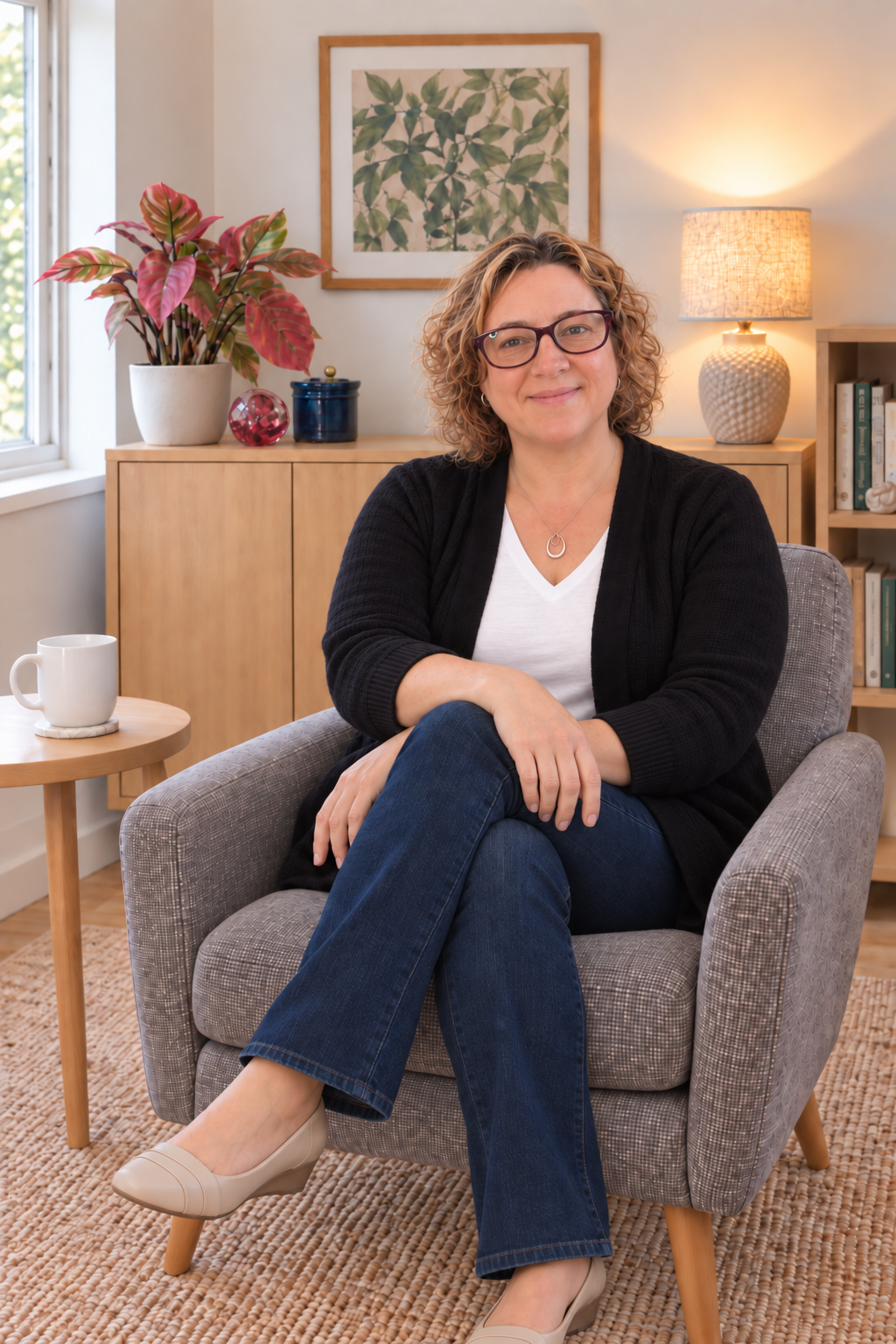
I work with adults who feel overwhelmed, stuck, or who are hard on themselves — often while trying to make sense of ADHD and the long shadow of difficult early experiences.
If you've spent a long time feeling capable in some areas of life, but completely stuck in others, you're in the right place. Many of the people I work with are: - navigating ADHD — diagnosed, late-diagnosed, or still wondering - feeling overwhelmed more quickly than other people - pushing themselves hard, but still feeling behind - trying to make sense of patterns that don't quite add up Often, they've spent years thinking they just needed to try harder. I offer psychology sessions via video, which means I work with adults across NSW and beyond — including people who find it easier to access support from home.
About Stephanie Green Registered Psychologist, Central Coast NSW
How I came to this work
Before becoming a psychologist, I worked in Human Resources, supporting people through difficult situations. I could help in the moment, but it never felt like enough. I wasn't helping in a way that created lasting change. That stayed with me. Over time, it led me to train as a psychologist — so I could work more deeply with people. Not just help them get through, but actually understand what was happening and find ways of doing things differently.
What I notice in my work
Over time, I found myself drawn to working with adults whose ADHD hadn't been recognised — or had been, but only recently. Many had reached their 30s or 40s before anyone joined the dots. And often, there was more to the picture: long-term stress, earlier life experiences that had quietly shaped everything. These were people who appeared capable on the outside, but who were exhausted from years of managing — often without understanding why things felt so much harder than they seemed to for others.
How this shapes the way I work
My work focuses on understanding what's actually happening underneath the surface. That means looking at: why things can feel overwhelming so quickly - patterns of shutdown, avoidance, or getting stuck - the pressure you put on yourself, and where it came from.
I'm a registered psychologist with 17 years of experience, with training in adult ADHD and Autism, trauma-informed therapy, and EMDR.
A bit more about me
I also have ADHD myself, which means I understand firsthand how these patterns can show up — and how much effort it takes to manage them when you don't yet understand what's driving them.
It also means I'm often off on a side quest. One year it was learning to cook the perfect steak. Another, making the best compost in the garden. This year, it's bread — and possibly learning how to cook fish. I also have mild synaesthesia — some smells have colours for me.
Like many of the neurodivergent people I work with, I've had to learn how to manage the less helpful parts of ADHD — things like: - taking on too much - pushing into perfectionism - not asking for enough support - experiencing energy crashes or burnout That learning didn't happen all at once, and it's still something I stay aware of.
I also see the strengths in ADHD — things like curiosity, problem solving, creativity, adaptability, and bursts of energy and focus. These aren't things to get rid of. They're things to work with.
What matters in the work
I’m interested in how things actually work for you, not a generic version of how they should work.
That means:
looking closely at patterns, not just symptoms
working at a pace that doesn’t tip you into overwhelm
being practical when it helps
making space for the parts of your experience that haven’t quite made sense before
If you’ve been tyring to make sense of things for a long time and nothing has quite fit, this is the kind of work I do. Sessions are delivered by video, so you can access support from wherever you are in Australia.